
Overview
There are more than 100,000 Defense Industrial Base companies and their subcontractors who perform under contract to the Department of Defense. Even one subcontractor who remains unsecure in their practices can lead to a breach where hackers compromise unclassified systems and exfiltrate technical specifications, including, in one instance, specifications for a supersonic anti-ship missile.
Small businesses with government contracts have been able to self-report their security tiers, but the rollout of the Cybersecurity Maturity Model Certification (“CMMC”) means a contractor’s cybersecurity measures are now a contractual condition. Small gaps like checking IDs and securing files will now be considered a breach of CMMC compliance.
This article will cover everything from what CMMC is to how it can manifest as a litigation risk. To see a more in-depth article read Katherine C. Fine and Anne K. Wilsons’ article in the Association of Business Trial Lawyers most recent report here. Need a more visual format? You can also access our recorded webinar on CMMC here with the passcode: 5TcP@G9=
What is CMMC?
CMMC is the Department of Defense’s (“DoD”) framework for verifying that companies in the federal supply chain are adequately protecting sensitive government information. To maintain a Cybersecurity Maturity Model Certification government contractors must meet the requirements of the Supplier Performance Risk System (“SPRS”). See the Requirements broken down below
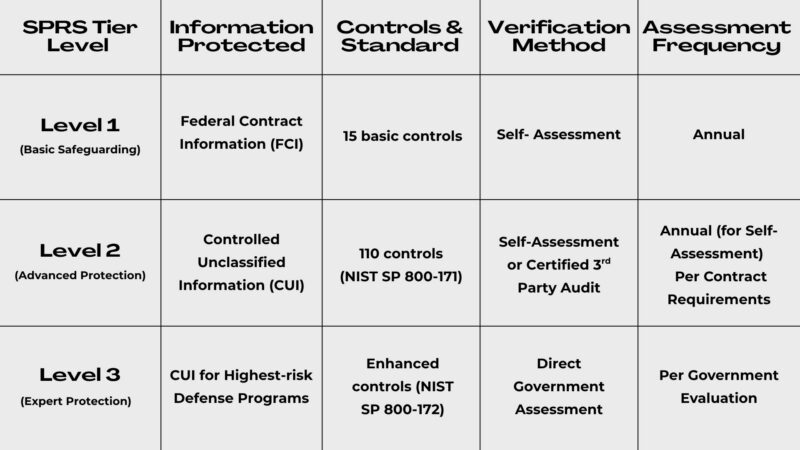
Keep in mind SPRS is measurable and thus serves as a standard that must be maintained to escape legal exposure.
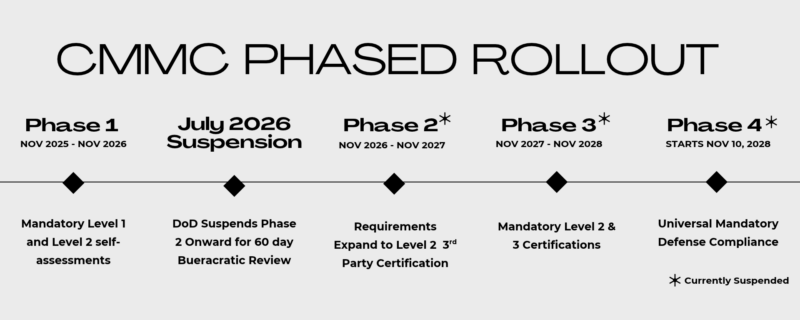
Phased Role Out
As the CMMC is phased in, over the next couple of years, the litigation risk will intensify. The current timeline is as follows, although it is subject to revisions throughout the implementation process.
Precedence
While we are currently only in Phase 1, CMMC compliance issues are already manifesting in the shape of ordinary commercial litigation: breach of contract, fraud, successor liability, and indemnification. We are already seeing this in action; see some examples below:
- United States v. LOGZONE, Inc.(2026): A defense logistics contractor was certifying a perfect score of 110 in SPRS only for a Defense Contract Management Agency audit calculating a true score of negative 170 out of -203. The gap between the claimed and actual scores was found to be fraud.
- United States v. Raytheon Company & Nightwing Group (2025): A defense contractor and its spun-off entity paid $8.5 million to resolve claims of non-compliant cybersecurity plans. This case warns that cybersecurity liabilities follow acquired and spun-off companies for years.
- United States ex rel. v. MORSECORP, Inc.(2025): A contractor settled for $4.6 million after its Head of Security blew the whistle on non-compliant cloud storage and delayed SPRS score fixes. It highlights that internal compliance staff can—and will—act as whistleblowers.
- United States v. Aero Turbine Inc.& Gallant Capital Partners (2025): A contractor and its private-equity owner paid $1.75 million because an investor executive actively managed company operations. This serves as a warning that parent firms face direct liability if they exercise operational control over a non-compliant subsidiary.
Read together, these cases map neatly onto core litigation practice areas: contract disputes sparked by default or non-renewal, M&A and successor-liability claims arising from thin due diligence, and whistleblower actions built on unresolved cybersecurity gaps.
Proactive Measures
Effective cybersecurity consulting comes down to two proactive pillars: setting clear expectations before a contract is signed and auditing self-assessments alongside subcontractors. Establishing expectations early keeps exposure and termination terms manageable, while giving a window to bring in external expertise so knowledge gaps don’t leave clients unprepared.
The next best measure is keeping clients out of the two biggest pitfalls: misreporting self-assessments and ignoring supply-chain risk. Auditing SPRS scores is critical because misreported numbers are the single most common trigger for False Claims Act (FCA) exposure. At the same time, prime contractors need to realize CMMC responsibilities don’t stop with them; keeping sub-contractors in line is directly the prime’s job. Doing just these two things will put a government contractor leagues above the others.
Bottom Line for Litigators
CMMC has quietly become a commercial-litigation issue wearing a cybersecurity costume. The disputes it generates (fraud, breach, successor liability, indemnification, whistleblower claims) are squarely within the business litigator’s wheelhouse. The lawyers who recognize that now, and counsel clients to get their SPRS scores and subcontractor terms in order before a problem matures, will save their clients from the far more expensive fight later.